How do we know if a planet is too light or too dense to be habitable for life as we know it on Earth? Moreover, do exoplanets in the habitable zone have a similar internal structure and chemical composition to that of Earth? I am collaborating with Earth Scientists to answer these questions. The figure below shows the density of about a dozen planets. This is from a nice work by Joe Schulze.

We can then use the following flowchart to determine if the planet is too light or too dense based on a comparison of the core mass fraction (CMF).

With the data published in Joe's paper, we can use a Gaussian Mixture Model to classify planets into super-mercuries and normal planets. We can also use a Hierarchical Bayesian Model to infer the frequency of each classification. Our work can be found in this paper by Joe, me, and collaborators.

Our latest work: does the host star matter?
Building on this, we asked whether the composition of small planets depends on the type of star they orbit. In our latest paper (Wang, Dorn & Bali, accepted by ApJ), we model the population-level density distribution of small planets around M dwarfs and around FGK stars, linking interior structure models to the observed densities.
The figure below compares the measured densities of planets in three samples. Each density is normalized by the density expected for a rocky planet of the same mass with an Earth-like core mass fraction (CMF) of 0.32, marked by the dashed line. Planets around M dwarfs (blue and orange) include a substantial population below this rocky reference, even after removing the TRAPPIST-1 planets. Planets around FGK stars (green) are systematically shifted to higher densities.
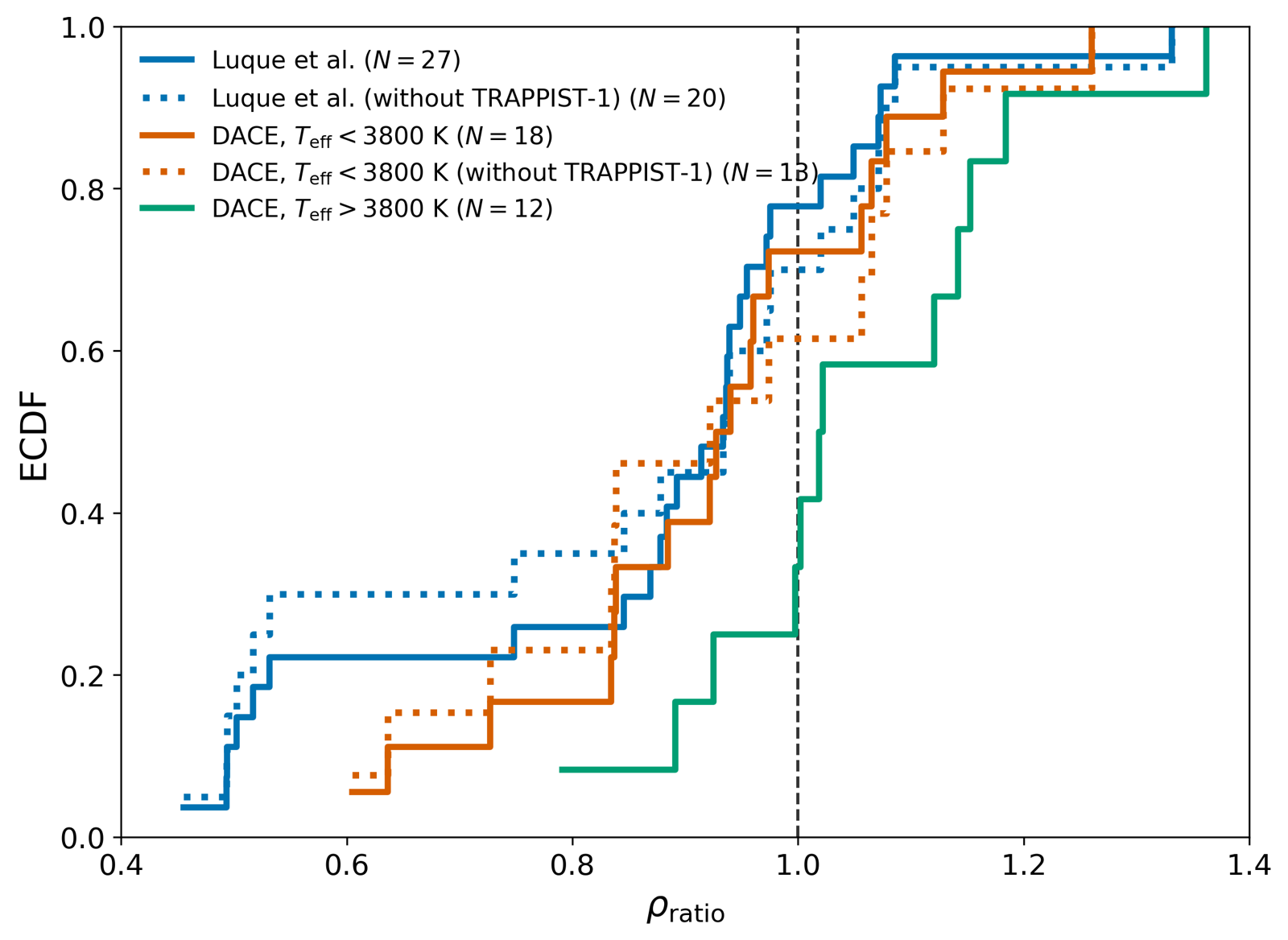
Our modeling finds that small planets around FGK stars have a CMF about 16% higher than those around M dwarfs. Put another way, 90–97% of the planets around FGK stars are rocky, compared with at most about 62% of the planets around M dwarfs. Volatile-rich planets are common, but they carry very little volatile material: for example, more than 99.5% of the gas-rich planets in the DACE M-dwarf sample have an atmosphere that makes up less than 0.01% of the planet’s mass. The composition of small planets, it turns out, depends strongly on their stellar environment.